


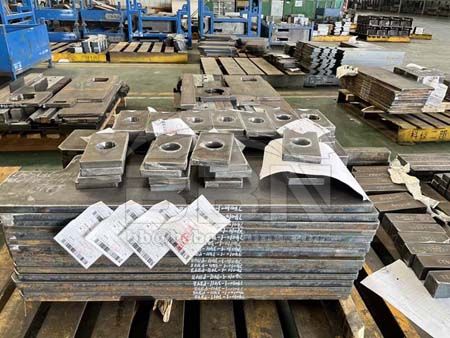
Optimizing cutting parameters is key to improving the accuracy of 321 stainless steel plate cutting. Adjusting the current and speed based on material characteristics is crucial. The empirical formula is V = K × I / δ (where K is the material coefficient and δ is the plate thickness). For every 10% increase in current, the speed can be increased by 15-20%, but the thickness-current safety limit must be strictly adhered to. For example, when cutting 30mm carbon steel, the current should be ≤260A; exceeding this limit can easily cause slag buildup, while insufficient current leads to arc interruption. Segmented variable speed control of the cutting trajectory is also essential. Straight sections use 100% of the rated speed, while areas with sudden changes in curvature are reduced to 70%, and hole and groove structures are further reduced to 50%.
Process reinforcement measures can effectively suppress deformation. The torch height should be maintained at 1.5-2 times the hole diameter. A real-time adaptive height adjustment system controls arc voltage fluctuations within ±5V, compensating for arc instability caused by surface undulations. Gas parameters need to be customized according to the material. Carbon steel uses oxygen + air curtain dual-gas protection with a pressure of 0.6-0.7 MPa; 321 stainless steel uses a nitrogen + hydrogen mixture with a pressure of 0.5-0.6 MPa; and aluminum alloys use an argon + helium mixture with a pressure of 0.4-0.5 MPa.
Intelligent compensation technology can predict and correct errors. A reverse shrinkage compensation amount is added during the CNC programming stage, with a compensation value of 0.1mm reserved for every 10mm of plate thickness. This is especially suitable for plates thicker than 20mm, counteracting dimensional shrinkage caused by heat accumulation. The CNC system monitors the arc voltage in real time, automatically adjusting the cutting speed by ±10% when fluctuations exceed 8%, maintaining a constant energy density per unit length. In addition, post-cutting treatments such as reserving a 0.1mm reverse compensation amount, edge grinding, and chemical treatment can further suppress deformation and improve corrosion resistance.
Just like you, 70% customers choose long-term cooperation with BBN steel not only for our good product and service quality, good reputation in the international market, but also for our experienced one-stop raw material supply and further steel processing!
Henan BEBON Iron&Steel co.,ltd.
 Language

 Online Consultation


