


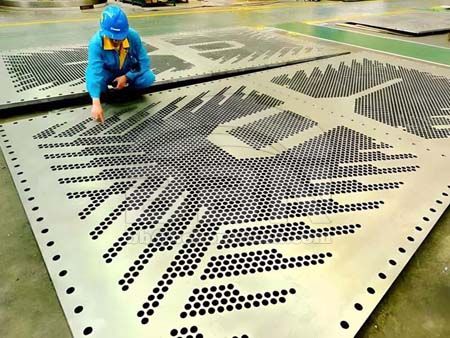
The tube sheet, as a core component of the heat exchanger, requires a design that complements the expansion joint in terms of rigidity and flexibility. The tube sheet secures the tube bundle via bolted connections and withstands axial forces under high-temperature and high-pressure conditions; the expansion joint utilizes its corrugated structure to absorb thermal expansion displacement. In the matching design, the rigidity of the tube sheet must be coordinated with the flexibility of the expansion joint to prevent tube bundle vibration or leakage caused by thermal stress. For example, in chemical equipment, an excessively thick tube sheet will limit the compensation capacity of the expansion joint, while an excessively thin one may lead to tube sheet deformation.
The geometric parameters of the tube sheet directly affect the performance of the expansion joint. The diameter, thickness, and hole size of the tube sheet must match the corrugated diameter and pitch of the expansion joint to ensure the continuity of the fluid channel. If the tube sheet holes are misaligned, it will lead to eccentric installation of the expansion joint, causing local stress concentration. In addition, the material selection of the tube sheet (such as carbon steel or stainless steel) must be compatible with the material of the expansion joint to prevent electrochemical corrosion. In offshore engineering, the matching of the tube sheet and expansion joint must consider the corrosive environment of seawater, and 316L stainless steel is usually used to enhance corrosion resistance.
The sealing structure of the tube sheet must work in conjunction with the compensation mechanism of the expansion joint. The tube sheet achieves sealing through gaskets or welding, while the corrugated deformation of the expansion joint compensates for the displacement of the tube sheet due to thermal expansion. In the matching design, the surface roughness of the tube sheet's sealing surface must match the contact surface of the expansion joint to prevent leakage due to uneven surfaces. For example, in the steam generators of nuclear power plants, the matching of the tube sheet and expansion joint must meet ASME standards to ensure zero leakage operation under high temperature and high pressure.
Just like you, 70% customers choose long-term cooperation with BBN steel not only for our good product and service quality, good reputation in the international market, but also for our experienced one-stop raw material supply and further steel processing!

Henan BEBON Iron&Steel co.,ltd.
 Language

 Online Consultation


